How to Choose Commercial Carports in 2026?
Choosing Commercial carports in 2026 requires more than comparing steel prices and roof shapes. Owners must connect protection, energy performance, safety, maintenance, and long-term operating costs.
The International Energy Agency Photovoltaic Power Systems Programme reported approximately 447 gigawatts of new photovoltaic capacity worldwide in 2023. This growth strengthens the case for solar-ready commercial carports, especially across retail centers, offices, warehouses, and transport facilities. Grand View Research identifies solar carports as a growing market, supported by electric-vehicle charging and renewable-energy investment. However, market growth does not guarantee a suitable project. The stakes are practical. A canopy must protect vehicles from intense sunlight, rain, snow, and wind. It must also preserve turning space, pedestrian visibility, lighting quality, and emergency access. Drainage details matter beside every parking bay.
Parking scholar Donald Shoup wrote, “Parking is too important to be left to the parking professionals.” His warning remains useful here. Commercial carports influence customer experience, property value, energy planning, and daily logistics. Buyers should review structural calculations, local wind and snow conditions, corrosion protection, warranty terms, installation records, and future charging capacity. ASCE 7 load provisions and applicable building standards should guide professional design review. A cheap proposal may conceal weak foundations or expensive maintenance. That assumption needs testing. No checklist is perfect. Site experience can expose problems that a spreadsheet misses. The best choice balances measurable performance with honest attention to the people using the parking area every day.
Define Your Commercial Carport Needs and Site Requirements
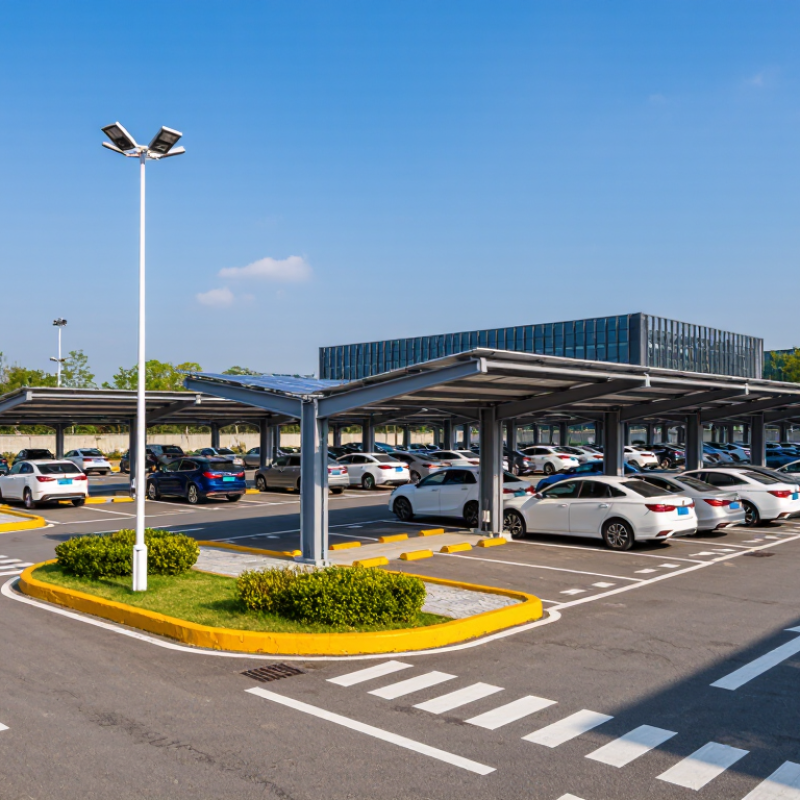
Choosing a commercial carport in 2026 starts with a clear definition of your site and daily operations. A warehouse serving delivery vans needs different coverage than an office parking area. Record the number of vehicles, their height, turning radius, and busiest arrival times. Do not estimate from today’s traffic alone. Growth can make a suitable structure feel cramped within a year.
Walk the site after rain and during peak activity. Note standing water, drainage paths, overhead cables, nearby trees, and delivery access. Measure boundaries, setbacks, underground utilities, and the distance between parking rows. A level drawing helps, but it should reflect real conditions. I have seen plans fail because they ignored a low corner where water collected.
Consider the users, too. Employees may need shaded spaces, while customers need simple access and clear visibility. Check lighting positions, pedestrian routes, emergency access, and snow or wind exposure where applicable. Your local project professional can confirm soil conditions, foundation needs, and required approvals. Reliable planning includes maintenance access for cleaning, lighting repairs, and surface drainage. It also leaves room for imperfect assumptions. Recheck every measurement before ordering materials. Small errors become expensive when posts, vehicles, and property lines meet.
Assess Installation Methods, Maintenance Needs, and Warranty Coverage
Choosing commercial carports in 2026 requires more than comparing roof shapes and prices. Installation conditions matter. Augered concrete footings suit new sites, while surface-mounted baseplates can reduce disruption on sound slabs. Driven posts may speed installation, but underground utilities and soil strength must be verified first. Wind, snow, drainage, and vehicle clearance should be documented by a qualified structural professional. The U.S. Bureau of Labor Statistics recorded 1,075 construction fatalities in 2023, so rushed installation is not a sensible saving.
Maintenance planning should begin before the first vehicle parks underneath. Inspect fasteners, welds, sealants, drainage paths, and protective coatings at least annually. Coastal air, de-icing salts, and standing water require closer inspections. EIA’s latest completed Commercial Buildings Energy Consumption Survey, covering 2018, reports that commercial buildings used about 18% of U.S. total energy. A shaded parking area may reduce vehicle heat, but it does not remove the need for clean drainage and sound lighting. Small defects become expensive. I have seen specifications overlook access for inspection, which creates avoidable maintenance delays.
Warranty coverage needs precise language. Separate structural, corrosion, paint, roofing, and workmanship terms. Ask who pays for labor, removal, replacement, and transport. Confirm whether wind events, snow loading, ponding water, and unauthorized modifications are excluded. A 20-year coating warranty is not a 20-year leak warranty. The International Code Council’s 2024 code framework also reinforces the need to match design assumptions with local conditions. Keep inspection records, photographs, and repair invoices. Without them, even a valid warranty can become difficult to enforce.
Calculate Total Costs, Long-Term Value, and Supplier Reliability
Choosing commercial carports in 2026 requires more than comparing the lowest installation quote. The real decision begins with total cost. Include site preparation, drainage, foundations, lighting, permits, delivery, installation, inspections, and future repairs. A quote that excludes these items may look attractive but create expensive surprises later. My first estimate was too optimistic because I ignored difficult ground conditions and overnight delivery charges.
Long-term value depends on performance, not appearance alone. Check the structure’s expected service life, corrosion protection, roof drainage, snow and wind ratings, and replacement-part availability. Ask for maintenance schedules and realistic cleaning costs. A slightly higher initial price may reduce repainting, water damage, and business disruption. However, projected savings are not guaranteed. Review the assumptions carefully. A spreadsheet can still hide weak data.
Supplier reliability should be tested before signing. Request project references from comparable commercial sites, written specifications, installation timelines, insurance details, and warranty terms. Speak with recent customers, not only selected testimonials. Confirm who handles structural questions after installation. Reliable suppliers answer specific questions without pressure and document every change. Delays matter. A two-week setback can affect employee parking, tenant agreements, or customer access. Keep a contingency budget, because even well-planned projects can encounter weather, permitting, or material delays.
How to Choose Commercial Carports in 2026? - Calculate Total Costs, Long-Term Value, and Supplier Reliability
| Carport Solution |
Typical Commercial Use |
Indicative Installed Cost
USD / sq. ft. |
Estimated Cost for
1,000 sq. ft. |
Expected Service Life |
Annual Maintenance
as % of Initial Cost |
20-Year Ownership Cost* |
Long-Term Value |
Key Risk to Verify |
| Open Galvanized Steel Carport |
Employee parking, visitor parking, fleet areas |
$18–$35 |
$18,000–$35,000 |
20–30 years |
1.0%–1.5% |
$25,000–$49,000 |
Lowest upfront cost; fast deployment |
Wind uplift, snow load, drainage, corrosion protection |
| Covered Steel Carport |
Retail, offices, hospitals, hotels, public facilities |
$25–$45 |
$25,000–$45,000 |
25–35 years |
1.0%–1.5% |
$34,000–$63,000 |
Better weather protection and user comfort |
Permit requirements, water management, foundation scope |
| Tensile-Membrane Carport |
Architectural developments, campuses, mixed-use sites |
$22–$40 |
$22,000–$40,000 |
15–25 years |
1.5%–2.5% |
$35,000–$67,000 |
Distinctive appearance and reduced structural weight |
Membrane replacement cycle, fire rating, fabric cleaning |
| Solar-Ready Steel Carport |
Large parking lots, EV charging, sustainability projects |
$35–$65 |
$35,000–$65,000 |
25–35 years for structure |
0.8%–1.5% |
$45,000–$95,000 before energy savings |
Potential energy revenue, shade, EV infrastructure |
Utility interconnection, structural loading, inverter replacement |
Cost assumptions: Planning ranges are in 2026 USD and may vary by region, site access, foundations, permits, engineering, utility work, labor rates, and material specifications. The 20-year ownership estimate includes the initial installation, routine maintenance, and one major renewal or replacement allowance where applicable. It excludes land, financing, taxes, insurance, and revenue from solar electricity.
Supplier Reliability Evaluation Checklist
| Reliability Dimension |
Recommended Evidence |
Minimum Acceptance Target |
Suggested Weight |
| Structural Engineering |
Stamped calculations, load tables, site-specific drawings |
Designed for local wind, snow, seismic, and soil conditions |
25% |
| Relevant Project Experience |
Three or more comparable commercial projects |
Verifiable references with similar size and site conditions |
15% |
| Warranty Clarity |
Separate material, coating, membrane, and workmanship terms |
Written exclusions, claim process, and transfer conditions |
15% |
| Schedule Performance |
Detailed production, permitting, and installation schedule |
Milestones, delay responsibility, and written change control |
15% |
| After-Sales Service |
Local service coverage, spare-parts plan, response procedure |
Defined response time and accessible maintenance support |
15% |
| Commercial Transparency |
Itemized quotation and payment schedule |
Clear exclusions, allowances, taxes, and change-order rates |
15% |
Decision rule: Select the option with the lowest risk-adjusted 20-year cost that satisfies local code requirements, operating needs, maintenance capacity, and the supplier reliability score—not simply the lowest initial quotation.