China Best Covered Walkways for Global Buyers?

Global buyers need more than attractive drawings when choosing Covered walkways. They need dependable shelter, clear specifications, and evidence that the supplier understands real pedestrian movement. Dr. John J. Fruin, a respected pedestrian-facility expert, wrote, “The pedestrian is the most vulnerable and least protected of all road users.” That principle remains important when evaluating covered connections between terminals, factories, schools, hospitals, and commercial buildings.

A reliable Covered walkways supplier should explain the complete system, not only the roof panel. Buyers should examine frame strength, corrosion protection, drainage channels, wind resistance, snow loads, lighting options, and maintenance access. Small details matter. A poorly positioned gutter can leave water beside a busy entrance. A narrow column layout can slow luggage carts and wheelchair users. Transparent panels may improve visibility, but they can also create heat and glare in strong sunlight.

Experience should be visible in completed projects, installation records, and practical responses to difficult site conditions. Ask for material certificates, coating information, load calculations, drawings, and after-sales procedures. Factory audits can reveal more than polished brochures. Still, no supplier is perfect. Even a strong design may require adjustment after local weather, traffic flow, or installation limits become clearer. That uncertainty deserves honest discussion. The best global partner is not necessarily the cheapest one. It is the supplier that communicates clearly, documents performance, and improves the design before problems appear.
China Best Covered Walkways for Global Buyers?

Types of Covered Walkways Manufactured in China

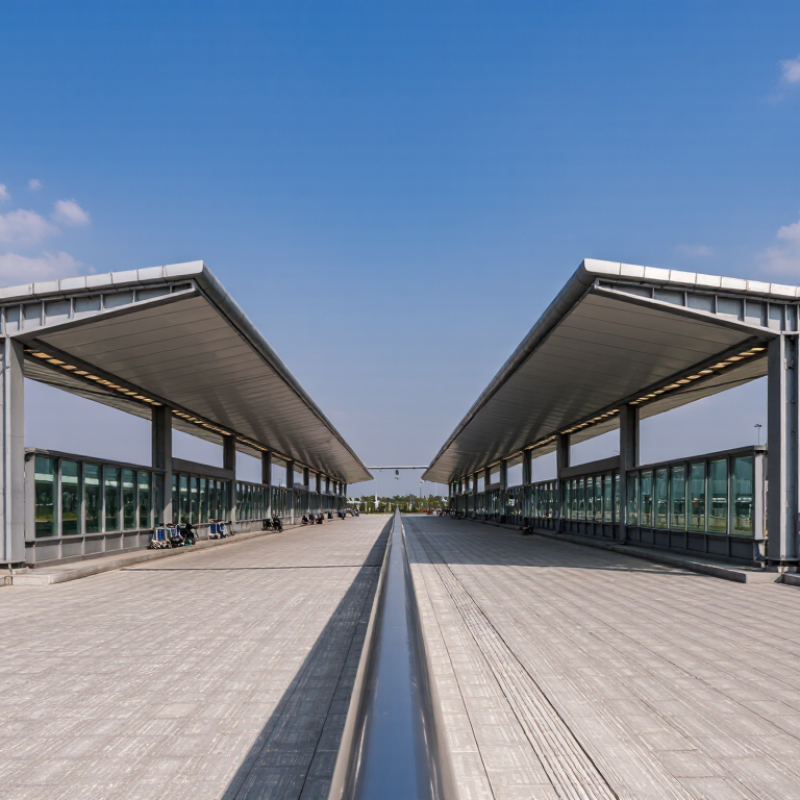
China’s covered walkway manufacturers produce several practical systems for global buyers. Polycarbonate walkways use lightweight panels, steel frames, and strong daylight transmission. They suit schools, hospitals, factories, and station connections. Tempered-glass walkways offer a cleaner appearance, but require stricter cleaning and impact-control plans.

Aluminum walkways resist corrosion and reduce structural weight. Galvanized-steel systems provide higher load capacity for long spans and windy sites. Tensile membrane walkways use coated fabric over steel columns. They create wide, bright shelters with less foundation work. Modular pedestrian corridors arrive in repeatable sections, which can shorten installation time. China’s National Bureau of Statistics reported construction industry output above RMB 31 trillion in 2023, indicating a deep domestic supply base. Grand View Research also identifies continued growth in the global polycarbonate sheets market, supported by lightweight architectural applications. These reports do not guarantee every factory’s quality. That detail matters.

Tips: Request drawings, wind-load calculations, drainage details, coating thickness, and material certificates before ordering. Compare sample joints, not only catalog photos. Check whether local installers can replace panels and seals. A low quotation can hide weak flashing or difficult maintenance. I have seen projects overfocus on appearance. Weather performance came later. That was an expensive lesson. Buyers should also confirm fire performance, snow loads, salt exposure, and delivery packaging against local requirements. Slight design changes may be necessary after site review. That is normal.

China-Made Covered Walkway Types for Global Buyers

The chart compares typical roof-light transmission ranges for common covered walkway systems manufactured in China. Transparent systems are suitable when daylight is a priority, while opaque metal-panel roofs generally provide stronger solar blocking and privacy. Actual performance varies according to material grade, thickness, surface treatment, color, and structural design.

Key Materials and Structural Design Features

China Best Covered Walkways for Global Buyers?

Covered walkways rely on practical material choices and disciplined structural design. Galvanized steel provides strong support for long spans and heavy weather loads. Aluminum reduces weight and resists corrosion in coastal environments. Polycarbonate roofing admits daylight while limiting direct rain exposure. Tensile membrane systems offer a lighter appearance, but they require accurate tensioning and regular inspection.

Material compatibility matters. Steel frames need protective coatings, especially near saltwater or industrial emissions. Stainless steel fasteners can reduce rust stains around joints. Polycarbonate panels should include thermal movement allowances, since temperature changes can cause cracking or deformation. Clear drainage channels should direct water away from entrances and pedestrian surfaces. Small details prevent larger maintenance problems.

Structural design must reflect local wind, snow, seismic, and accessibility requirements. Columns should not narrow walking routes or obstruct mobility equipment. Bracing needs careful placement, particularly on long, exposed walkways. A perfectly rigid canopy is not always better. Controlled movement can protect connections during temperature changes and strong winds. In site inspections, drainage is often overlooked. That remains a design weakness. Global buyers should request load calculations, material certificates, coating specifications, and maintenance guidance before production. Samples also deserve testing under realistic weather conditions. A roof may look excellent in a catalog, yet perform differently after repeated heat, rain, and freezing cycles.

Performance Standards for International Projects

China Best Covered Walkways for Global Buyers?

Performance Standards for International Projects

A covered walkway for an international project needs more than an attractive roof. It must match local wind, snow, seismic, fire, and accessibility requirements. Site records matter too. A walkway beside a coastal hospital faces salt spray, strong gusts, and constant pedestrian traffic. Its steel or aluminum frame should resist corrosion through suitable materials, coatings, and drainage design.

Reliable suppliers should provide structural calculations, material certificates, welding records, and inspection reports. Ask for load assumptions in clear language. Roof panels need tested resistance against impact, ultraviolet exposure, and temperature changes. Water must leave through planned slopes and gutters, not random gaps. Small failures become expensive during rainy seasons. Poorly sealed joints often reveal this problem first.

International buyers should also check installation tolerances and replacement access. A damaged panel should not require dismantling the entire walkway. Factory inspections and sample testing can reduce uncertainty before shipment. However, paperwork is not enough. A drawing may satisfy one code and still miss local foundation conditions. That weakness deserves review. Project teams should confirm drainage, wind direction, emergency access, and maintenance methods with local engineers. Performance depends on the complete system, including foundations, connections, lighting, and site work. Even a well-tested design may need adjustment after installation. That is normal, but undocumented changes create future risks.

China Best Covered Walkways for Global Buyers? - Performance Standards for International Projects

Performance Dimension Recommended Project Requirement Reference Standard or Design Basis Verification Method International Buyer Consideration
Structural Safety Design the primary frame, columns, foundations, connections and roof system for the governing combination of permanent, imposed, wind, snow, seismic and maintenance loads. Applicable national building code; Eurocodes EN 1990 and EN 1991, or the designated local structural design code. Stamped structural calculations, connection design, shop drawings and inspection records. The governing code must be agreed before fabrication because load combinations differ by country and site.
Pedestrian Live Load Use a preliminary imposed-load range of approximately 3.0–5.0 kN/m² for heavily used pedestrian areas, subject to the project code and occupancy classification. EN 1991-1-1 and the applicable national annex, or the local building code. Load calculation review and, where required, controlled load testing. Increase the design basis where crowding, luggage carts, cleaning equipment or queueing is expected.
Wind Resistance Determine site-specific basic wind speed, exposure, pressure coefficients, uplift, overturning and local cladding pressures. EN 1991-1-4, ASCE 7 or the applicable national wind code. Wind-load calculations, anchor-bolt checks, base-plate inspection and site installation records. Coastal, typhoon, hurricane and open-terrain locations normally require enhanced analysis and anchorage.
Snow and Ice Loads Check roof snow, drifting, unbalanced accumulation and ice-related drainage blockage where applicable. EN 1991-1-3 or the applicable local snow-load standard. Site climate data, roof-load calculations and inspection of drainage and snow-retention details. Snow values must be based on the project location rather than a generic regional average.
Seismic Performance Assess frame stability, non-structural panels, movement joints, anchors and connections in seismic zones. EN 1998, ASCE 7 or the governing national seismic code. Seismic design calculations and inspection of bracing, anchors and expansion joints. Covered walkways connecting separate buildings may need movement joints at building interfaces.
Clear Walking Width Target approximately 1,500 mm clear width for comfortable two-way pedestrian movement; maintain the legally required accessible route width. ISO 21542, EN 17210, ADA 2010 or the applicable accessibility regulation. As-built dimensional survey and accessibility inspection. Do not reduce the clear route with columns, gutters, signs, lighting or handrails.
Accessible Gradient and Transitions Avoid steps along the accessible route; where ramps are required, use the maximum slope permitted by the local accessibility code and provide level landings. ISO 21542, EN 17210, ADA 2010 or local accessibility requirements. Digital level measurement, landing checks and tactile-edge inspection where required. Thresholds, expansion joints and drainage channels should be flush or carefully detailed to prevent trip hazards.
Slip Resistance Select a profiled or textured walking surface suitable for wet conditions, with the required rating confirmed by the local specification. Project slip-resistance specification; DIN 51130, EN 13845 or other recognized test method where applicable. Manufacturer test report and, when required, independent site testing. Covered does not mean dry; wind-driven rain, condensation and tracked water must be considered.
Fire Performance Specify the required reaction-to-fire class for roof, wall, lining, insulation and translucent panels according to the building location and escape strategy. EN 13501-1, ASTM E84, NFPA provisions or the applicable local fire code. Classification reports, product certificates and installation inspection. Fire requirements may be stricter when the walkway forms part of an evacuation route or connects public buildings.
Corrosion Protection Select hot-dip galvanizing, a compatible coating system or stainless materials according to exposure, expected service life and maintenance access. ISO 1461 for hot-dip galvanized coatings; ISO 12944 for protective paint systems and corrosivity categories. Coating-thickness measurement, surface-preparation records and visual inspection. Marine, industrial and de-icing-salt environments generally require higher corrosion protection than inland sites.
Rainwater Drainage Provide adequate roof falls, gutters, downpipes, overflow paths and discharge points without creating wet or icy walking surfaces. Local plumbing and drainage code; rainfall intensity based on site climate data. Hydraulic calculation, water-flow test and inspection of outlets and overflow provisions. Discharge should not undermine foundations, obstruct public routes or drain across accessible entrances.
Thermal Movement Allow for expansion and contraction of long steel, aluminum, polycarbonate and glass components, especially at building connections. Structural design code and manufacturer installation requirements. Movement-joint calculations, sealant inspection and interface detail review. Use flexible interfaces where the walkway is attached to buildings with different movement characteristics.
Lighting and Visibility Provide uniform lighting appropriate to pedestrian traffic, entrances, ramps, stairs, crossings and security requirements. EN 12464-1, CIE guidance or the applicable local lighting standard. Illuminance and uniformity measurements after installation. Coordinate lighting, drainage and structural members to avoid glare, dark zones and water ingress.
Materials and Traceability Use documented steel grades, fastener grades, panel specifications, welding procedures and batch traceability suitable for the approved design. EN 1090, ISO 3834, ASTM material standards or the specified national material standard. Mill certificates, welding records, non-destructive testing where specified and material receiving inspection. Require English-language documentation and consistent grade equivalency before substituting materials.
Installation and Quality Control Control foundation positioning, anchor installation, bolt tightening, weld quality, panel alignment, sealant application and final tolerances. Approved inspection and test plan; ISO 9001 quality-management principles; project-specific specifications. Factory acceptance inspection, site inspection, punch-list closure and as-built documentation. A pre-approved inspection and test plan reduces disputes in international procurement and installation.
Maintenance and Service Life Provide replaceable seals, accessible gutters, inspection points, drainage cleaning access and a documented maintenance schedule. Project service-life specification; ISO 12944 durability guidance where coated steel is used. Operations and maintenance manual, handover inspection and periodic condition surveys. Total cost of ownership should include cleaning, recoating, seal replacement and access equipment.

Note: Final requirements must be confirmed by the project’s engineer, authority having jurisdiction and applicable national codes. The values shown are procurement and preliminary-design guidance, not a substitute for site-specific calculations.

How to Evaluate Chinese Covered Walkway Suppliers

China Best Covered Walkways for Global Buyers?

How to Evaluate Chinese Covered Walkway Suppliers

Evaluating a Chinese covered walkway supplier requires more than comparing prices. Request technical drawings, material grades, roof thickness, drainage details, and wind or snow-load calculations. A reliable supplier should explain how columns, joints, and foundations work together. Ask for recent project references with similar climate and pedestrian traffic. Site photos help, but signed inspection records offer stronger evidence.

Visit the factory when possible. Observe welding quality, surface preparation, cutting accuracy, and packaging methods. Ask how steel or aluminum batches are traced from delivery to production. Check whether independent testing supports claims about corrosion resistance, fire performance, and structural capacity. Certificates alone may not reveal weak installation practices. Speak with the engineering contact, not only the sales representative. Clear answers matter.

Small details matter.

Review tolerances, anchor layouts, replacement-part access, and cleaning requirements before signing. Confirm who handles site measurements, installation supervision, damage claims, and warranty response. Request a sample section or finish panel if appearance matters. A low quotation can hide transport changes, foundation work, or local compliance costs. I have seen evaluations focus heavily on factory machinery while overlooking communication delays. That mistake is easy to repeat. No checklist is perfect, so record unanswered questions and test the supplier’s response time before placing a large order.

Global Purchasing, Customization, and Export Considerations

For global buyers, choosing a covered walkway from China requires more than comparing unit prices. The walkway must match the project’s climate, traffic flow, and installation conditions. Share accurate drawings, span lengths, roof preferences, and site photos before requesting a quotation. Small details matter.

Customization may include steel or aluminum frames, polycarbonate panels, glass, lighting, gutters, and drainage outlets. Ask for material grades, coating thickness, weld standards, and load calculations. In snowy or windy regions, local engineering requirements should guide the design. A supplier may offer a beautiful structure that performs poorly on your site. That risk deserves attention.

Export planning also affects the real cost. Confirm product dimensions, packing methods, container loading plans, and spare-part arrangements. Request production drawings before fabrication, then inspect key points such as welds, surface finish, hole positions, and panel protection. Factory audits and third-party inspections can improve reliability. Do not rely only on photographs.

Incoterms, customs documents, insurance responsibilities, and destination delivery should be clearly written in the contract. Confirm whether installation guidance, manuals, and replacement components are included. A low quotation can hide expensive local work. I have seen projects lose time because packaging was treated as an afterthought. Careful purchasing is slower at the beginning, but usually cheaper when the walkway arrives.