Best Intelligent Pole Manufacturers in China for Global Buyers
For global buyers, choosing among the best Intelligent Pole manufacturers in China means looking beyond polished product photos. An Intelligent Pole may combine LED lighting, cameras, environmental sensors, public Wi-Fi, and communications equipment on one mast. Each component adds value, but also creates integration and maintenance questions. Details matter.
Urban-technology scholar Carlo Ratti offers a useful caution in the title of his book: “The City Is Not a Computer.” A connected pole should serve real street conditions, not simply collect devices. Buyers should examine engineering drawings, material specifications, software compatibility, weather protection, and the supplier’s testing process. Ask how cables are routed, how access panels open, and who diagnoses faults after installation. These details are easy to overlook in a sales presentation.
This guide compares manufacturers through practical criteria: product range, customization, documented quality processes, project experience, and support for overseas delivery. A factory visit or independent inspection can reveal more than a catalogue. Request references for installations with similar climates and equipment loads. No supplier is perfect. Even a capable manufacturer may depend on outside partners for software, sensors, or field servicing. That can be manageable, but only when responsibilities are clear. The right choice is not necessarily the most feature-rich pole; it is the one whose performance, interfaces, and long-term support match the buyer’s project.
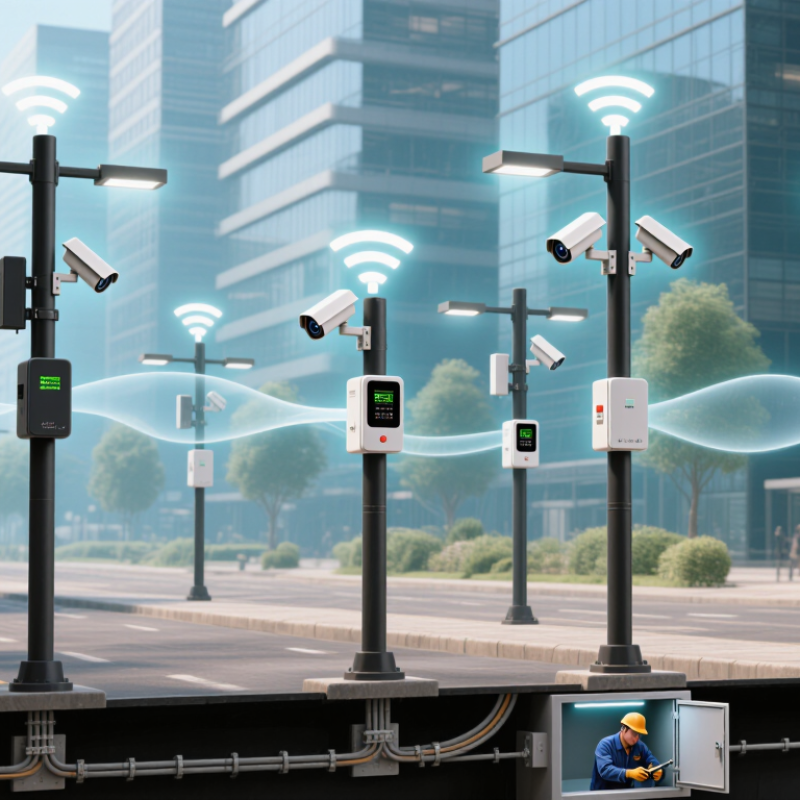
Intelligent Poles Explained: Integrating 5G, LED Lighting, Sensors, and Public Wi-Fi
Intelligent poles combine several street-level systems on one structure. A pole may carry LED luminaires, 5G radio units, environmental sensors, and public Wi-Fi access points. Each component has different power, mounting, and maintenance needs. The design must leave room for cables, cooling, and safe access. Small details matter. For example, a poorly placed radio unit can complicate lamp servicing, while exposed connectors may suffer in rain or dust. Sensors also need thoughtful positioning; a temperature reading beside a warm luminaire may not represent the surrounding street.
For global buyers, evaluating manufacturers means looking beyond a rendered image. Ask how the pole separates power and data cables, supports equipment replacement, and handles heat and wind loads. Request drawings, material specifications, and test records for the intended configuration. Check that lighting controls, network hardware, and sensors can communicate through documented interfaces. Public Wi-Fi needs practical attention to coverage, user privacy, and routine software updates. Integration can reduce visual clutter, but it also concentrates equipment on one asset. That trade-off deserves a real maintenance plan, not just a product brochure. The first installation may reveal issues that drawings missed.
Core Technical Benchmarks: IP66 Protection and IK10 Resistance to 20 J Impacts
For global buyers assessing intelligent pole manufacturers in China, IP66 and IK10 should be verified on the complete pole assembly, not just listed in a brochure. IEC 60529 defines IP6X as dust-tight protection and IPX6 as protection against powerful water jets. That matters around exposed camera ports, cable glands, and display seams. Water finds gaps. Ask for the test configuration, sample photographs, and a report identifying the tested enclosure and accessories.
IEC 62262 classifies IK10 impact resistance at 20 joules. A useful reference is a 5 kg impactor dropped from 400 mm, equivalent to 20 J of energy. The rating helps compare housings, but it does not prove every lens, bracket, or sensor survives repeated impacts in service. Small details matter. Check whether the test covered the installed orientation and vulnerable components. Also inspect coating damage, fastener movement, and seal condition after impact testing. A report can be current and still miss a field weakness. I would request independent laboratory results and clarify whether the tested sample matches the production design.
China’s Intelligent Pole Manufacturers: Product Portfolios, Certifications, and Export Experience
China’s intelligent-pole manufacturers offer more than lighting columns. Typical portfolios combine LED luminaires, cameras, environmental sensors, public-address systems, and wireless equipment. Some suppliers also provide control platforms and customized pole designs. The ITU’s Facts and Figures 2023 estimated that 5.4 billion people, or 67% of the global population, used the internet. This highlights the value of connected infrastructure, but does not guarantee a project’s commercial success. Integration still matters. A camera, controller, and lamp may each pass tests, while the assembled system remains difficult to maintain.
For global buyers, check certificates against the exact product and destination market. ISO 9001 concerns quality management; it is not product approval. Where applicable, request relevant conformity documents and test reports for radio modules, power supplies, and the finished assembly. Export experience is easier to assess through comparable project references, installation records, spare-parts plans, and clear warranty terms. A polished catalogue proves little on its own.
Tips: Ask for a sample bill of materials and component test reports. Confirm who handles customs documents, local-language manuals, and replacement parts. Then verify references independently.
Supplier Evaluation: Comparing Connectivity, Modular Design, Customization, and Lifecycle Costs
For global buyers, an intelligent pole is a network node, not just a lamp post. Ask suppliers to document supported communication protocols, backhaul options, cybersecurity updates, and sensor compatibility. GSMA’s Mobile Economy 2024 report counted 1.6 billion 5G connections at the end of 2023, underscoring the growing need for adaptable connectivity. But a 5G-ready label proves little by itself. Request a live demonstration showing how lighting, cameras, and environmental sensors share data, and what happens when the network fails. Test it on an actual pole, not only in a presentation.
Modular design affects maintenance as much as installation. Check whether a damaged controller, radio, or power unit can be replaced independently, using parts stocked locally. Confirm mounting dimensions and electrical interfaces before ordering; small differences can turn a standard replacement into a custom job. Customization should cover climate, pole height, finishes, and sensor placement, with clear drawings and acceptance tests. Price the full lifecycle: installation, connectivity fees, software support, energy use, spares, and end-of-life handling. The IEA’s Digitalisation and Energy report estimated that digital technologies could save up to $80 billion annually in electricity-system costs. That estimate is system-wide, not a guaranteed saving for pole projects. A spreadsheet can still miss delayed repairs and vendor lock-in. Ask suppliers to state assumptions, then compare costs over the same service period.
Intelligent Pole Supplier Evaluation: Example Buyer-Side Weighting
A practical starting point for comparing connectivity, modular design, customization, and lifecycle costs. These are example procurement weights—not supplier ratings or market-survey results—and should be adjusted to fit project requirements.
Global Procurement and Deployment: Standards Compliance, Site Planning, and After-Sales Support
Global buyers need more than a pole that looks ready in a catalog. They need evidence. Before ordering, confirm applicable electrical, electromagnetic compatibility, and environmental requirements with local authorities and project engineers. Ask suppliers for current test reports, material specifications, and clear interface documentation for cameras, sensors, and communications equipment. A certificate alone does not prove that a complete installation will perform as expected. Details matter.
Site planning should begin with a surveyed location, not a generic layout drawing. Check wind exposure, soil conditions, underground utilities, maintenance access, and nearby power or network connections. For solar-powered units, estimate seasonal sunlight and battery autonomy using realistic local data. Small errors add up. Review mounting height and equipment loads together, since later changes can affect stability and service access. Too often, teams discover conflicts after foundations are poured.
After delivery, agree on commissioning records, response times, spare-part availability, and firmware update responsibilities. A useful support plan names who handles remote diagnostics and who visits when a fault persists. Keep records. Pilot installations can reveal weak assumptions before a large rollout, although they add time and cost. That trade-off deserves honest discussion. No supplier can remove every site risk; reliable partners explain limits, document decisions, and help teams correct issues openly.

